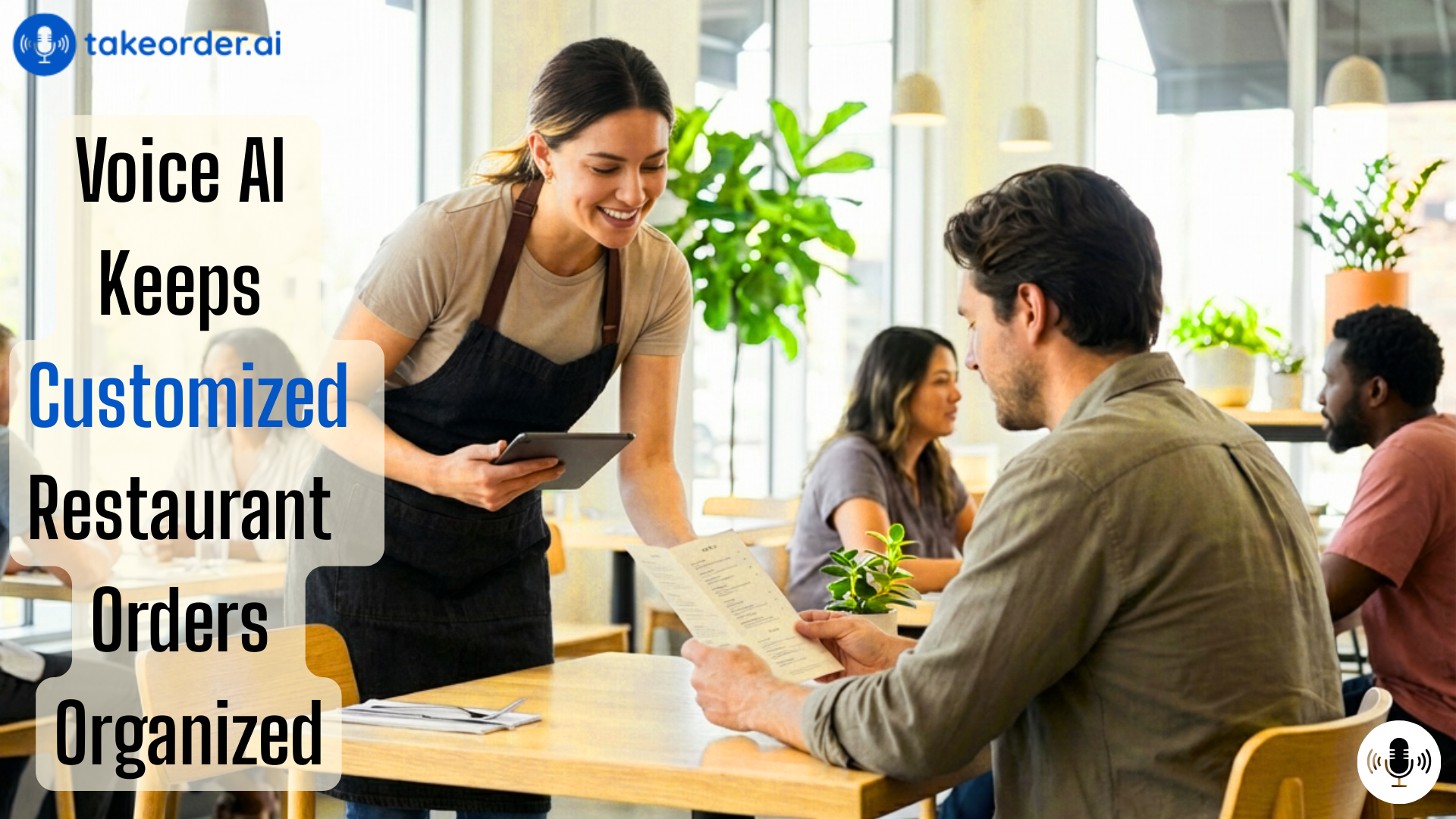
Customization used to be optional. Today, it is expected.
Modern diners no longer order strictly from the menu. They personalize every item. They remove ingredients. They add extras. They split portions. They swap sides. They adjust spice levels. They request dairy-free, gluten-free, low-carb, extra sauce, light cheese, and half-and-half combinations.
From the guest’s perspective, it feels simple.
From the restaurant’s perspective, it creates operational complexity at scale.
Every additional modifier introduces risk. Every substitution adds another decision point. Every dietary request requires precision. And when these requests are spoken quickly over the phone, through a drive-thru speaker, or during a peak-hour rush, small misunderstandings turn into expensive mistakes.
The “Can I customize this?” question is no longer occasional. It is constant. And without structured order automation, customization becomes chaos.
This is where Voice AI is transforming restaurant operations.
Customization itself is not the problem. The breakdown happens in how it is captured.
Customers speak conversationally:
“I’ll take the pasta, but no cream, add mushrooms, and can you make half of it spicy?”
Point-of-sale systems, however, require structured selection fields. Staff must quickly translate free-flowing speech into categorized inputs. Under time pressure, that translation process introduces friction. Modifiers are missed. Portions are entered incorrectly. Add-ons are forgotten.
The gap between how guests speak and how systems process information is one of the largest contributors to order inaccuracy.
During peak periods, restaurants face simultaneous demands:
When staff juggles multiple channels, cognitive overload increases.
Missed calls become missed revenue. Rushed entries become inaccurate tickets. Incomplete orders become remakes.
Customization during high-volume windows is where profitability is most vulnerable.
Modern menus are no longer linear.
A single menu item can include:
This layered structure creates modifier stacking, where one order contains five to ten unique adjustments.
Without intelligent order automation, complexity scales faster than staff capacity.
A missed topping is not a minor inconvenience. It creates a measurable financial impact.
Customization errors lead to:
Restaurants operate on thin margins. Even small error percentages compound significantly over time.
Order accuracy is directly connected to revenue protection.
Operational clarity is directly connected to profitability.
Customization is expanding across nearly every restaurant category. As expectations rise, operational systems must evolve.
Pizzerias manage some of the most complex modifier combinations in the industry:
Each pizza can represent layered decision logic.
With Takeorder AI’s Pizza AI, natural language ordering is converted into clean, structured POS entries. Every modifier is captured clearly, reducing remakes and improving kitchen workflow.
QSR environments face continuous order variation:
When speed is critical, accuracy often suffers.
With Drive-Thru AI and Phone AI, restaurants automate order capture across channels, reducing pressure on frontline staff while improving consistency.
Customization is deeply embedded in beverage culture:
These layered preferences create repeated clarification cycles.
Voice AI eliminates repetition by accurately capturing conversational requests and confirming structured outputs instantly.
Build-your-own concepts have expanded rapidly:
These restaurants rely heavily on phone and digital orders, where clarity is essential.
Takeorder AI integrates directly into POS systems, reducing manual entry and minimizing modifier errors.
Explore the full solution suite here.
Ghost kitchens operate on scale.
They manage:
Automation is not optional in these environments. It is foundational.
Voice AI ensures structured order flow, protecting kitchen efficiency and reducing operational bottlenecks.
Voice AI bridges the gap between conversational speech and structured restaurant systems.
Voice AI understands how guests actually speak. It captures layered requests, half portions, substitutions, and dietary flags without requiring structured phrasing.
Orders move directly into the POS system without manual re-entry.
This reduces:
AI systems do not place customers on hold. They handle multiple incoming calls at once, preventing revenue leakage from abandoned orders.
AI-driven upsell prompts increase average ticket size while maintaining clarity and confirmation.
Together, these capabilities strengthen:
When customization is structured and automated:
Voice AI does not replace hospitality. It protects it.
By removing friction from order capture, teams can focus on service rather than damage control.
Every modifier matters.
Every missed ingredient costs money.
Every customization affects guest perception.
The “Can I customize this?” question is not a problem. The lack of structured order automation is.
Voice AI keeps restaurant orders clean, accurate, and profitable, even during peak chaos.
If your restaurant is managing growing customization demands, it may be time to upgrade how those requests are captured.
Because great hospitality begins with getting the order right.
Stay updated on our news and events! Sign up to receive our newsletter.
Thank you for signing up!
Something went wrong. Please try again later.