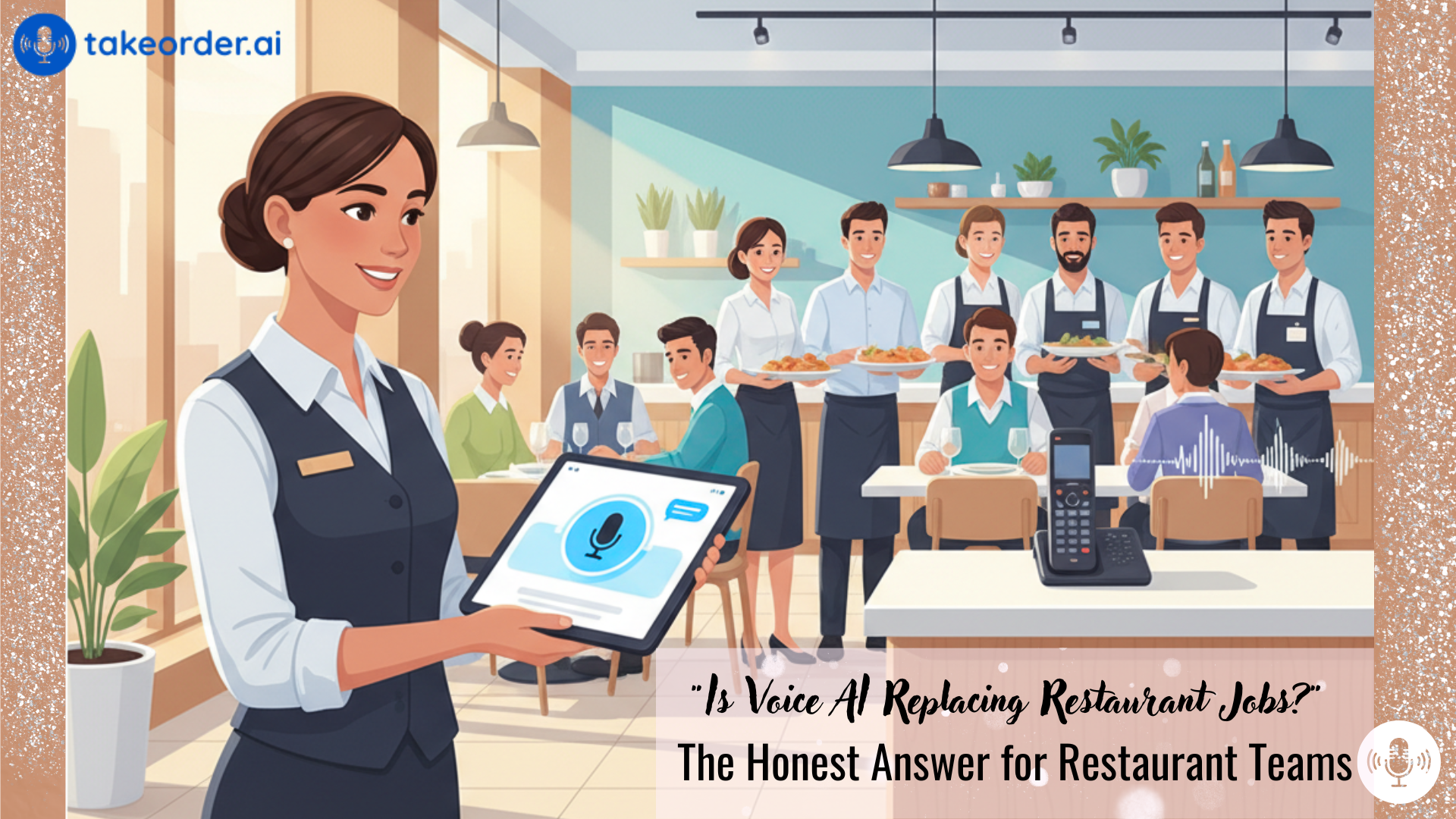
Walk into any restaurant break room in 2026, and you’ll probably hear the same quiet question floating around:
“Is voice AI going to take our jobs?”
It’s not just owners wondering about automation anymore. Hosts, cashiers, servers, kitchen teams, and shift managers are all hearing about AI phone ordering systems, restaurant automation tools, and conversational AI for restaurants. And naturally, when technology enters the workplace, people worry about job security.
So let’s talk about it honestly.
Is voice AI replacing restaurant jobs?
Or is something else really happening inside modern restaurants that adopt AI phone answering systems and conversational ordering technology?
The answer isn’t dramatic. It isn’t dystopian. And it definitely isn’t what most people fear.
Restaurants have always been people-powered. Hospitality is human. Service is personal. Smiles, tone of voice, remembering regular customers, that’s what makes a restaurant feel alive.
So when teams hear phrases like:
It’s easy to assume that fewer humans will be needed.
But here’s the truth: most headlines don’t explain.
Voice AI in restaurants is not replacing human hospitality. It is replacing repetitive friction.
There’s a big difference.
Let’s break this down clearly.
When restaurants implement an AI phone ordering system, what usually changes?
Voice AI is built to handle structured, repeatable conversations, not human nuance, empathy, or team collaboration.
And that distinction matters.
Before AI entered the picture, restaurant teams were already stretched thin.
Across fast food, QSRs, pizzerias, cafés, and full-service restaurants, the real issues look like this:
When you look closely, AI isn’t replacing stable, comfortable jobs.
It’s stepping into chaotic gaps that already existed.
Many restaurants adopting conversational AI for restaurant phone ordering are doing it because:
That’s not a replacement story. That’s a support story.
When a restaurant installs a voice AI phone ordering system, something subtle but powerful happens.
The phone stops being a stress trigger.
Imagine this scenario:
Now imagine the same moment, except:
What changes?
The team breathes.
This is where the long-tail reality becomes clear:
AI phone ordering systems reduce restaurant staff stress during peak hours.
That’s not a job replacement. That’s operational relief.
This is the question everyone wants answered directly.
In most independent restaurants and growing chains, AI does not lead to mass layoffs.
Instead, it leads to:
In some cases, restaurants may choose not to hire additional staff because AI covers certain repetitive tasks.
But that’s different from firing a loyal team.
It’s more accurate to say:
Voice AI changes how restaurant teams work, not whether they work.
Technology rarely eliminates work. It shifts it.
With AI adoption in restaurants, we’re seeing:
When AI handles the predictable conversations, humans handle the meaningful ones.
That shift actually elevates team roles rather than shrinking them.
This concern is especially strong in:
The fear sounds like this:
“If we bring in AI phone ordering software for small restaurants, won’t we need fewer people?”
In reality, small restaurants benefit the most because:
For small teams, AI doesn’t remove a person. It acts like an extra invisible assistant.
An assistant who:
But still requires humans to deliver food, create experiences, and build loyalty.
Here’s the honest answer:
No, voice AI is not replacing restaurant teams.
It is replacing:
It is enhancing:
The long-term trend isn’t fewer people in restaurants.
It’s a smarter task allocation inside restaurants.
In the coming years, the most successful restaurants won’t be the ones that avoid technology.
They’ll be the ones that blend:
Human warmth + Conversational AI efficiency.
Guests will still want:
AI cannot replicate genuine hospitality.
But it can remove the friction that prevents teams from delivering it.
If you’re part of a restaurant team and feeling uncertain about AI:
Ask not, “Will it replace me?”
Ask instead:
“How will it change what I focus on each shift?”
Chances are, it will remove the tasks you dislike most:
And it will give you more space to do what restaurants are truly about: People.
Voice AI in restaurants isn’t about replacing humans.
It’s about giving humans back the time, focus, and energy to deliver exceptional hospitality.
And that’s not a threat.
That’s an upgrade.
Stay updated on our news and events! Sign up to receive our newsletter.
Thank you for signing up!
Something went wrong. Please try again later.