Running a restaurant in today’s competitive market takes more than great recipes and friendly service. Rising food costs, labor shortages, delivery apps, online reviews, and changing customer expectations have transformed how restaurants grow. Marketing is no longer optional; it is essential for survival and long-term profitability.
The good news?
You don’t need a complicated marketing plan. You need a simple, structured framework that works.
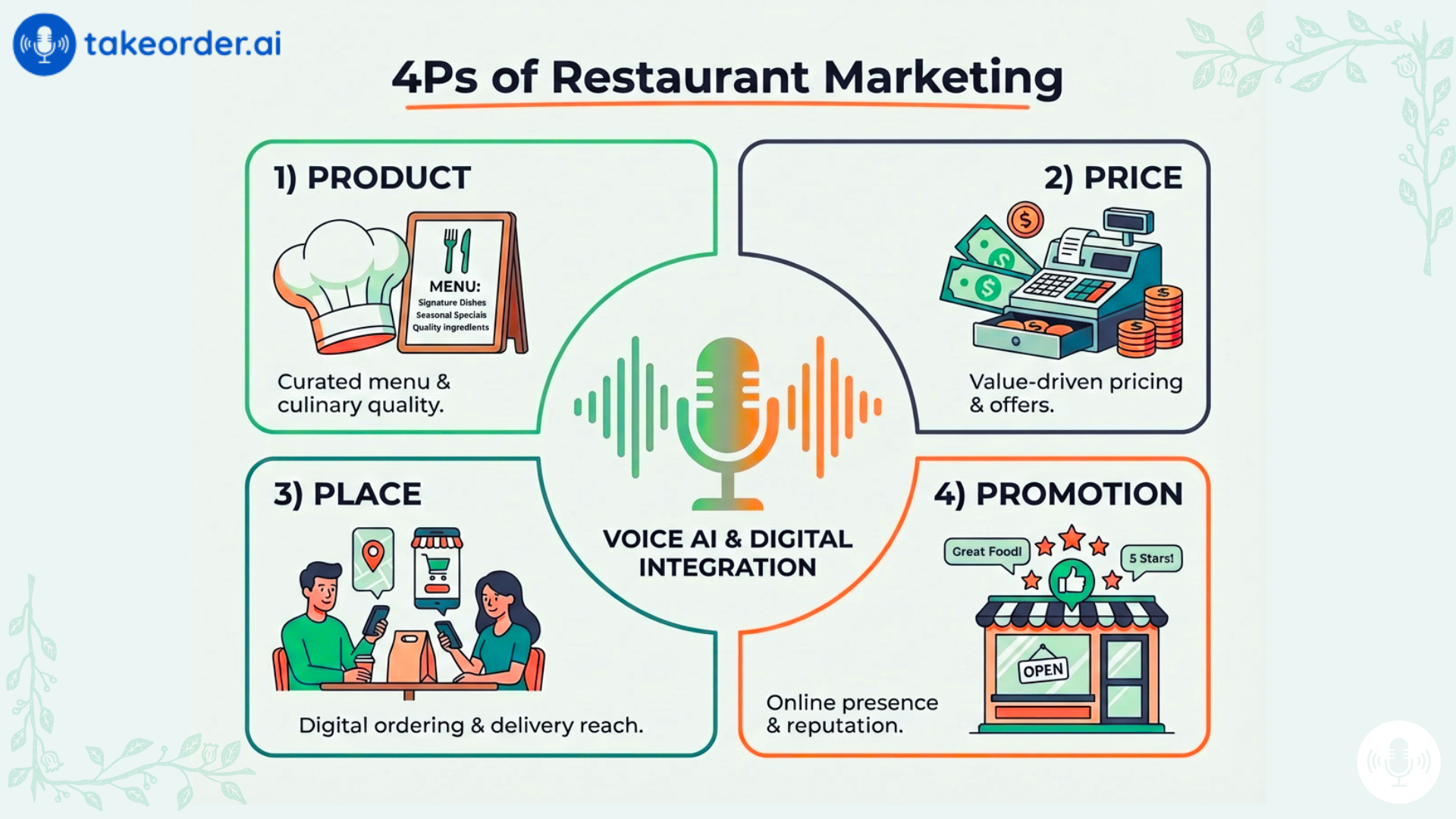
That framework is the 4Ps of restaurant marketing: Product, Price, Place, and Promotion. When these four elements align, they create a powerful restaurant marketing strategy that improves customer retention, increases revenue, strengthens brand positioning, and drives sustainable growth.
In the modern restaurant industry, when combined with Voice AI and automation technology, the 4Ps become even more effective.
Let’s break it down in a practical way built specifically for busy restaurant owners.
The 4Ps framework was introduced by E. Jerome McCarthy as a simplified way to structure marketing strategy. Though developed decades ago, it remains highly relevant for modern restaurant marketing.
In simple terms:
Many restaurants focus heavily on promotions, social media posts, discounts, and ads, without optimizing the other three areas. But true restaurant growth happens when all four Ps work together. If your menu is weak, your pricing is unclear, your ordering process is frustrating, or your online presence is inconsistent, promotion alone won’t create lasting results.
At first glance, your product is your food. Menu items, ingredients, presentation, portion size, and consistency all shape how customers perceive your restaurant. However, a successful restaurant menu strategy goes beyond taste. It includes smart menu engineering, strategic item placement, and profitability analysis.
Menu engineering allows you to identify high-margin dishes, remove low-performing items, and reduce food waste. A focused menu improves kitchen workflow, reduces errors, and enhances operational efficiency. When your menu is strategically designed, it supports both profitability and customer satisfaction.
Your real product extends beyond the plate. Guests evaluate the entire dining experience, speed of service, order accuracy, staff friendliness, ambiance, and convenience. A restaurant that answers calls promptly, delivers orders accurately, and maintains a clean, welcoming atmosphere builds stronger brand loyalty.
Missed calls, long hold times, and incorrect orders damage your product more than many owners realize. In the digital era, convenience is part of what you are selling.
Modern restaurant technology plays a direct role in strengthening your product. Voice AI systems and restaurant automation tools improve order accuracy, reduce wait times, and ensure consistency across shifts.
For example, solutions like Takeorder AI allow restaurants to automate phone ordering with natural conversational flow. Every call is answered, every customization is confirmed, and no order is missed. This enhances customer satisfaction, increases operational efficiency, and protects revenue during peak hours.
When your product includes reliability and convenience, marketing becomes easier because customers experience quality at every touchpoint.
Pricing is often one of the most challenging decisions for restaurant owners. Many fear raising prices, assuming customers will leave. However, underpricing can harm your brand perception and limit profitability.
A sustainable restaurant pricing strategy begins with understanding food cost percentage, prime cost (food plus labor), and target profit margins. Without tracking these numbers, pricing decisions become guesswork. Strong pricing supports reinvestment in marketing, staffing, and technology upgrades.
Customers do not always choose the cheapest option. They choose what feels valuable. Pricing psychology plays a powerful role in restaurant marketing.
Strategic anchor pricing, premium menu placement, and bundled meal options influence purchasing decisions. For example, offering a premium signature dish at a higher price can make mid-tier options appear more attractive. Combo meals increase average ticket size while giving customers the perception of savings.
When pricing aligns with your brand positioning, it strengthens overall customer perception.
Technology enhances pricing strategies through consistent upselling. AI-powered ordering systems can suggest add-ons, drinks, sides, or desserts in a natural tone without relying on staff memory.
Unlike human employees who may forget to upsell during busy shifts, automation ensures every order receives the same revenue-boosting suggestions. Over time, this increases average order value significantly and supports overall restaurant revenue growth.
Smart pricing is not about lowering numbers; it is about maximizing value and consistency.
Your physical location still matters. Visibility, parking access, neighborhood demographics, and foot traffic influence daily revenue. A well-positioned restaurant benefits from natural exposure and walk-in customers.
However, physical location alone is no longer enough.
Today, “place” includes your digital footprint. Your website, Google Business Profile, online ordering system, and mobile optimization all impact discoverability.
Local SEO for restaurants ensures you appear in search results when customers look for terms like “best burgers near me” or “pizza delivery open now.” Without strong digital optimization, you risk losing customers to competitors who are easier to find online.
A seamless, user-friendly website and updated online menu significantly improve conversion rates.
Modern restaurants operate across multiple channels: dine-in, takeout, delivery, drive-thru, and phone orders. Each channel represents an opportunity to increase revenue, but also a potential friction point.
Long wait times, busy phone lines, and confusing ordering processes reduce sales. Customers expect speed and convenience.
Voice AI and restaurant automation reduce these friction points by answering calls instantly, confirming orders clearly, and handling high call volumes during peak hours. This ensures no revenue is lost due to missed calls or overwhelmed staff.
Place is no longer just about geography; it is about accessibility and ease of purchase.
Promotion becomes powerful when supported by strong product, pricing, and placement strategies. Local restaurant marketing includes encouraging online reviews, participating in community events, and building partnerships with nearby businesses.
Positive reviews significantly impact consumer decisions. Managing your online reputation and responding professionally to feedback strengthens brand trust.
Social media marketing allows restaurants to stay visible and build relationships with customers. You do not need viral content; consistency is more important than perfection.
Posting behind-the-scenes kitchen moments, new menu items, limited-time offers, and customer testimonials builds authenticity. Short-form video content is particularly effective for increasing engagement and reach.
When social media reflects your brand personality, it reinforces the overall marketing strategy.
Owning your customer database is a powerful asset. Email marketing and SMS campaigns allow you to promote events, seasonal specials, and loyalty rewards directly to customers who already know your brand.
Paid advertising can accelerate growth when used strategically. Google Ads target high-intent local searches, while social media ads build awareness and promote limited-time offers. Tracking marketing ROI ensures that every dollar spent contributes to measurable growth.
Promotion amplifies what already works. Without strong foundations, promotion becomes expensive and ineffective.
Restaurant technology integrates marketing and operations seamlessly. Voice AI enhances product quality through accuracy and speed. Automated upselling strengthens pricing strategies. Multi-channel integration improves place by reducing friction. Data collection supports promotion by enabling targeted marketing campaigns.
Restaurants that adopt AI-driven solutions position themselves as modern, efficient, and customer-focused. Automation reduces labor strain, increases order consistency, and supports long-term profitability.
In a competitive industry, small operational improvements create significant marketing advantages.
The 4Ps of restaurant marketing remain one of the most effective frameworks for modern restaurant success. By strengthening your product, pricing strategically, optimizing accessibility, and promoting consistently, you build a sustainable system for growth.
When supported by Voice AI and automation, this framework becomes even more powerful. Marketing no longer feels overwhelming because it connects directly to operations and measurable results.
For busy restaurant owners, simplicity is key. Focus on optimizing one “P” at a time. Small improvements compound over months, leading to stronger brand recognition, higher customer retention, improved operational efficiency, and consistent revenue growth.
The 4Ps are not just a marketing theory. They are a practical roadmap for thriving in today’s digital, technology-driven restaurant landscape.
Stay updated on our news and events! Sign up to receive our newsletter.
Thank you for signing up!
Something went wrong. Please try again later.